
Feasibility of easily accessible hearing screening in German municipal offices: A pilot study
Uwe Baumann 1Christiane Völter 2
Anke Lesinski-Schiedat 3
1 Goethe University Frankfurt, University Hospital, ENT/Audiological Acoustics, Frankfurt am Main, Germany
2 St. Elisabeth Hospital, Ruhr University Bochum, ENT Department, Bochum, Germany
3 Hanover Medical School, Clinic & German Hearing Center, Hanover, Germany
Abstract
The World Health Organization (WHO) recommends systematic hearing screening across the lifespan, particularly for older adults, as part of evidence based strategies to mitigate the global burden of hearing loss. However, no EU member state has implemented a nationwide adult hearing screening program. This pilot study investigated the feasibility of conducting in municipal citizen offices in Germany a simple, tablet based pure-tone audiometry and explored preliminary outcome patterns. Results from Frankfurt show high public acceptance and a substantial proportion of previously undetected hearing impairment among adults aged 50 years and older. These findings align with international evidence underlining the importance of early detection and support the potential role of municipal office in public health–oriented hearing care pathways. This study was the first to implement hearing screenings within a municipal citizen service center.
Introduction
Age related hearing loss (ARHL) is one of the most common chronic conditions worldwide and the third leading cause of years lived with disability. According to recent analyses, over 1.5 billion people globally live with some degree of hearing loss, and many cases are preventable or manageable with timely detection and intervention [1], [2].
Despite strong international recommendations, such as the WHO World Report on Hearing, adult hearing screening is not yet systematically implemented in EU member states. At a European Parliament round table in 2023, experts emphasized the need for standardized adult hearing screening and proposed a European Hearing Health Strategy to address unmet needs among older adults [3], [4].
Municipal citizen offices (Bürgerämter) represent easily accessible, high-traffic locations that could facilitate the early detection of health risks by integrating preventive health testing into routine administrative visits. All residents regularly visit these municipal offices approximately every 10–15 years throughout their lives. This study evaluates the feasibility and acceptance of such an approach.
Methods
Hearing screening was performed via a validated Android based pure tone self test (HearingTest, e-audiologia.pl) using a Tablet device, USB amplifier (Antelope ZEO, Elektrosfera Ltd, Sofia, Bulgaria) and circumaural headphones (VIC Firth SIH2, Zildjan, Norwell, USA, Figure 1 [Fig. 1]). The screening device was frequency specific coupler based calibrated. Test frequencies were 500 Hz, 1 kHz, 2 kHz, 4 kHz, 6 kHz.
Figure 1: Android-tablet equipped with a USB amplifier and circumaural headphones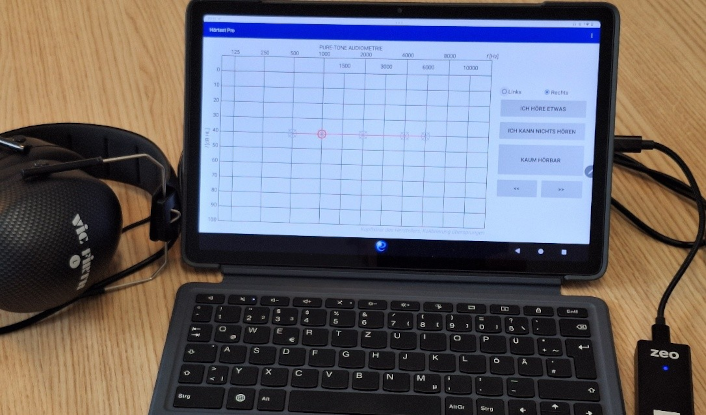
Prior to testing, the study’s background was explained to each participant, followed by the acquisition of written informed consent. A research assistant then instructed the participant on how to operate the application. The screening test was performed independently by the participant under the direct supervision of the research assistant.
Thresholds ≥35 dB HL at two adjacent frequencies were classified in either ear as abnormal. This screening threshold was selected because a hearing loss of 35 dB HL or greater on the better-hearing ear is marked as clinically relevant, marking the point where functional communication deficits typically emerge according to the WHO World Report on Hearing (2021) [5].
Guidelines emphasize that validated, calibrated pure tone methods are appropriate for adult hearing screening when implemented with standardized protocols [5].
Besides Frankfurt am Main (acoustically favorable office environment, Leq<40 dB(A)) screening was also planned in Bochum (corridor section with visitors passing by) and in Hanover (test conducted in waiting area). The present analysis focuses exclusively on the Frankfurt cohort; results from the remaining sites will be presented in a forthcoming publication as data collection was still ongoing during the work on this manuscript. Participants were recruited through flyers, digital displays, and personal approach. Participants were actively recruited and tested at the Frankfurt site from November 2025 to February 2026 during standard operating hours of the citizen service center.
Subject questionnaire
To gather relevant anamnesis data, a structured short questionnaire was administered following the hearing test to all participants. The core items were designed in alignment with standard European EuroTrak survey methodologies, which rely on self-reported hearing metrics to assess population-wide hearing loss prevalence and hearing aid uptake. The questionnaire comprehensively assessed:
- Prior awareness of hearing impairment, including the possession, regular usage, and perceived benefit of hearing devices (sub-questions for known hearing loss)
- Subjective hearing difficulties in daily life, specifically focusing on situational challenges encountered in social gatherings (noise) or in quiet environments (sub-questions for individuals without a prior diagnosis)
- External feedback, evaluating whether the participant’s social environment had previously noted any signs of a hearing deficit
- Audiological history, documenting whether pure-tone audiometry test had been performed in the past, including knowledge of its outcome and whether a hearing aid had been recommended by a medical doctor
Responses were recorded using a standardized closed-ended format (categorical options: “Yes”, “Partially”, “No”, and “No answer”) to ensure consistent quantitative analysis.
Results
Feasibility and acceptance
A precise participation or refusal rate could not be quantified for two main reasons: first, the total number of citizens visiting the municipal service center during the study period was not recorded, and second, not every visitor was explicitly invited to participate. Recruitment relied on a passive and semi-active approach, including a prominent roll-up banner placed in the main thoroughfare, the distribution of information flyers, and direct personal invitations initiated by a research assistant in the foyer. Nevertheless, the high acceptance of the low-barrier screening is robustly demonstrated by the unexpectedly rapid enrollment of the study cohort. The target sample size was reached significantly faster than anticipated, allowing data acquisition to be concluded two months ahead of the original recruitment schedule.
A majority of participants (86%) rated the test as easy or very easy. Average testing time was short (<4 min), enabling seamless integration into administrative workflows. These findings are consistent with EU pilot data showing strong public receptiveness to community based hearing screening initiatives [4].
Screening outcomes
In total, N=350 participants (189 females) were recruited. Average age was 43.4 years (SD 15.8 years). Among participants aged ≥50 years (N=124), N=36 showed abnormal findings requiring follow up. In this age group, N=13 had no prior knowledge of a hearing impairment. Only two participants of those with bilateral impairment used hearing aids. This gap reflects broader European patterns where self reported hearing difficulty is common, yet hearing aid uptake remains low—a phenomenon also documented in the EuroTrak and other epidemiological surveys [6].
The distribution of screening results across the different age groups reveals a clear, age-dependent increase in hearing screening failures (Figure 2 [Fig. 2]). To accurately interpret these percentages, it is critical to consider the decreasing sample sizes within the older age cohorts.
Figure 2: Distribution of screening results (percentages) over the different age groups, total N=132 (72;31;14;7 by group). Green: unremarkable finding (total N=88; by group N=62;23;3;0), yellow: one ear abnormal (total N=18; by group N=7;4;6;1), red: both ears abnormal outcome (total N=18; by group N=3;4;5;6). Criterion for “hearing loss”: two adjacent frequencies ≥35 dB HL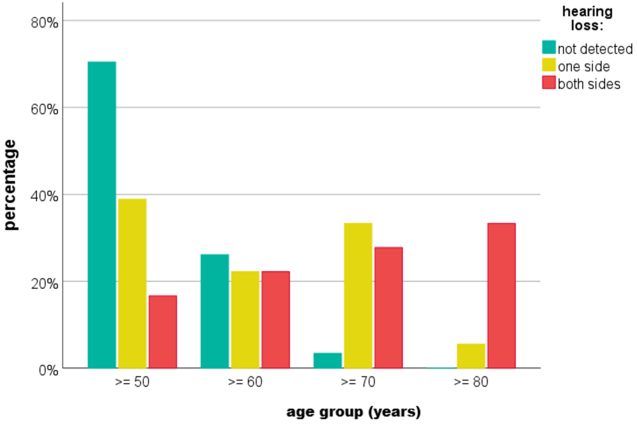
In the youngest cohort (50–59 years, N=72), the vast majority of participants showed unremarkable results (86.1%, N=62), while only 9.7% (N=7) failed in one ear and 4.2% (N=3) failed in both ears. This distribution shifts progressively with advancing age. In the oldest cohort (80+ years, N=7), no participant showed an unremarkable finding (N=0). Instead, 14.3% (N=1) failed the screening in one ear, and the large majority 85.7% (N=6) showed an abnormal outcome in both ears. The sharp percentage increase in bilateral hearing screening failures in the oldest groups (e.g., 35.7% in the 70–79 cohort and 85.7% in the 80+ cohort reflects the clinical reality of age-related hearing loss, even though the absolute numbers of participants in these highest age brackets were small (N=14 and N=7, respectively). Within each distinct age group, the sub-categories of unremarkable, unilateral abnormal, and bilateral abnormal findings reached exactly 100%.
Self reported hearing history
Among abnormal cases ≥50 years, N=14 had never undergone a hearing test. N=27 reported no previous recommendation for a hearing aid. 27% reported no difficulty in group conversations despite measurable impairment, supporting evidence that self report often underestimates audiometric loss [6].
Age-related patterns
Abnormal findings increased markedly in the age groups of 60-80+years, consistent with epidemiological data on ARHL prevalence across Europe [7], [8]. As depicted in Figure 2 [Fig. 2], the amount of abnormal findings in both ears raised form 18% (age group 50–60 years) to 36% (age group 80+ years).
Discussion
The present pilot data from the investigation site in Frankfurt a.M. demonstrate that municipal offices are feasible sites for hearing screening, with a high user acceptance and a practical workflow integration. Importantly, the proportion of previously undiagnosed hearing loss aligns with international findings on unmet needs in adult hearing care. Evidence indicates that untreated hearing loss contributes to reduced quality of life, cognitive decline, and social isolation, and is linked with higher risk for faster progression of dementia. Early detection—especially in older adults—is therefore critical for prevention oriented health policy [1].
The substantial number of undetected cases in this pilot study suggests that embedding hearing screening into the routine civic infrastructure could reduce barriers such as lack of awareness, limited access to specialists, and stigma. This aligns with WHO guidance calling for systematic, accessible adult hearing screening pathways at national and local levels [3].
Operational implementation, challenges, and testing environment
Conducting a clinical screening study within a highly frequented public administrative environment poses logistical and institutional challenges. Securing approval from the municipal citizen service center in Frankfurt am Main required extensive coordination. Data acquisition was conducted entirely during regular municipal business hours. To avoid any disruption to official administrative workflows, a strict routing procedure was implemented: visitors were required to fully complete their scheduled public services prior to being invited to participate in the screening. Due to concerns regarding potential long-term interruptions to standard operational processes, the management of the municipal center in Frankfurt remains critical toward a permanent establishment of such screening programs within their facilities.
Despite these bureaucratic hurdles, the physical testing conditions at the Frankfurt site were excellent. Measurements were conducted in a fully enclosed, separate office room equipped with an acoustic ceiling, ensuring a highly controlled and quiet environment that minimized ambient noise interference. As the acoustic conditions at the test centers in Bochum and Hanover were considerably poorer, the impact of room and environment acoustics on the feasibility of hearing screening in public offices remain to be analyzed once data collection is complete.
The role of supervision and future directions
It must be emphasized that the automated screening was performed under the constant supervision of a trained research assistant who provided initial instructions and oversaw the process. While this setup ensured high data quality and low technical error rates, it limits the generalizability regarding true self-containment. To transition this low-barrier approach into a highly scalable, community-based screening tool, future research must systematically evaluate to what extent this test can be operated fully autonomously by participants without any clinical or technical staff present.
Limitations
Several limitations of this pilot study must be acknowledged. First, a major limitation is the lack of a clinical-audiometric follow-up examination to validate the screening failures with standard diagnostic pure-tone audiometry. Second, it is well established that an automated self-test method yields slightly higher thresholds—on average 3 to 4 dB poorer—specifically at high frequencies (4 and 6 kHz) compared to manual audiometry. This methodological variance may have led to a slight overestimation of hearing loss severity in some participants. Lastly, while the screening program was generally well received, the precise response rate could not be quantified, as the total number of citizens visiting the municipal center who declined to participate was not systematically recorded. Future larger-scale implementations should include structured logging of non-participants to provide a robust measure of public acceptance.
Conclusion
This pilot study confirms that hearing screening in municipal offices is both operationally feasible and well accepted by the public. A considerable proportion of older adults demonstrated abnormal results, many previously unknown, highlighting the potential public health impact of an easily accessible community-based screening. The approach may serve as a model for a broader implementation as a part of EU and WHO strategies promoting healthy aging and early detection of sensory impairment. Ongoing evaluations from additional pilot sites (Bochum, Hanover) will help refine operational models and inform scalability.
Notes
Conference presentation
This contribution was presented at the 28th Annual Conference of the German Society of Audiology and published as an abstract [9].
Ethics statement and informed consent
The experimental protocols and the study design were formally reviewed and approved by the Ethics Committee of the Goethe University Frankfurt (approval number/Geschäftszeichen: GZ 2025-2274). The study was conducted in strict accordance with the ethical principles outlined in the Declaration of Helsinki. Prior to any testing or data collection, the background and purpose of the screening were explained to all participants, and written informed consent was obtained from each individual.
Acknowledgements
This research was supported by the Internationale Hörstiftung, Hanover, the Stiftung zur Hör- und Sprachförderung, Friedberg, and the participating municipal offices. The authors thank Isabell Best (MED-EL, Starnberg) for her ongoing support.
Use of AI
During the preparation of this manuscript, the authors used Gemini (Google) and ChatGPT (OpenAI) to improve the linguistic quality, formatting, and structural clarity of the text. After using this tool/service, the authors reviewed and edited the content as needed and take full responsibility for the final content of the publication.
Competing interests
The authors declare that they have no competing interests.
References
[1] Stancel-Lewis J, Dening T, Heffernan E, Davis AC, Henshaw H. Hearing screening for healthy aging: the U.K. should take a targeted approach. Gerontologist. 2026;66(3):gnaf295. DOI: 10.1093/geront/gnaf295[2] Prasad K, Borre ED, Dillard LK, Ayer A, Der C, Bainbridge KE, McMahon CM, Tucci DL, Wilson BS, Schmidler GDS, Saunders J. Priorities for hearing loss prevention and estimates of global cause-specific burdens of hearing loss: a systematic rapid review. Lancet Glob Health. 2024 Feb;12(2):e217-e225. DOI: 10.1016/S2214-109X(23)00514-4
[3] World Health Organisation. Hearing screening: considerations for implementation. Geneva: WHO; 2021.
[4] Hearing Health Forum EU. Active Ageing through Healthy Hearing: The Importance of Hearing Screening in the EU. 2023 [updated 2023 Nov 29; cited 2026 Apr 2]. Available from: https://www.hearinghealth.eu/wp-content/uploads/2024/12/European-Parliament-event-report-1.pdf
[5] World Health Organisation. World report on hearing. Geneva: WHO; 2021.
[6] Laureyns M, Bisgaard N, Best L, Zimmer S. Getting the numbers right on hearing loss, hearing care and hearing aid use in Europe – Report 2024. 2024 [updated 2024; cited 2026 Sep 7]. Available from: https://efhoh.org/2024/03/getting-the-numbers-right-on-hearing-loss-hearing-care-and-hearing-aid-use-in-europe-report-2024/
[7] Roth TN, Hanebuth D, Probst R. Prevalence of age-related hearing loss in Europe: a review. Eur Arch Otorhinolaryngol. 2011 Aug;268(8):1101-7. DOI: 10.1007/s00405-011-1597-8
[8] European Commission. Final Report Summary - AHEAD III (Assessment of Hearing in the Elderly: Aging and Degeneration - integration through immediate intervention). CORDIS; 2011 [updated 2011 Mar 24; cited 2026 Sep 7]. Available from: https://cordis.europa.eu/project/id/200835/reporting
[9] Baumann U, Völter C, Lesinski-Schiedat A. Pilot-Studie zur Anwendbarkeit des Hörscreenings in deutschen Gemeindeämtern/Bürgerbüros. In: Deutsche Gesellschaft für Audiologie e. V., editor. 28. Jahrestagung der Deutschen Gesellschaft für Audiologie. Oldenburg, 04.-06.03.2026. Düsseldorf: German Medical Science GMS Publishing House; 2026. Doc057. DOI: 10.3205/26dga057