
[Optimal sitzende Ohrpassstücke mittels additiver Fertigung: Charakterisierung der Hafteigenschaften im Tribologielabor]
Vitalij Joukov 1Henrik Mallwitz 2
Steffen Kreikemeier 2
Joachim Albrecht 1
1 Research Institute for Innovative Surfaces FINO, Aalen University of Applied Sciences, Aalen, Germany
2 Center of Excellence in Audiology, Aalen University of Applied Sciences, Aalen, Germany
Zusammenfassung
Ein zentrales Kriterium für die Gesamtleistung von Hörgeräten ist der zuverlässige Sitz der Otoplastiken im Gehörgang, um Tragekomfort und Funktionalität sicherzustellen. Eine unzureichende Haftung kann zu akustischen Leckagen und im Extremfall zum unbeabsichtigten Verlust des Geräts führen, insbesondere unter dem Einfluss von Kieferbewegungen, die mit einer Verformung des Gehörgangs einhergehen. Additive Fertigungsverfahren ermöglichen die Herstellung von Otoplastikoberflächen aus Polymeren mit maßgeschneiderten Mikrotopografien, die die reibungsbedingte Haftung im Gehörgang erhöhen. Dadurch lässt sich das Risiko eines unbeabsichtigten Verlusts der Otoplastik durch Herausfallen reduzieren.
In dieser Arbeit stellen wir einen Ansatz zur Charakterisierung des Adhäsionsverhaltens additiv gefertigter, mikrostrukturierter Polymeroberflächen gegenüber einem Modell der Oberfläche des menschlichen Gehörgangs vor. Das Modell wird durch einen Elastomerzylinder realisiert und mithilfe eines Oszillationstribometers untersucht. Die Methode bildet den Übergang von Haft- zu Gleitreibung durch eine oszillierende Auslenkung nach, wie sie im Alltag durch kaubedingte Kieferbewegungen hervorgerufen wird. Dazu wird ein 3D-gedruckter, mikrostrukturierter kugelförmiger Gegenkörper mit konstanter Normalkraft auf einen Elastomerzylinder gepresst, dessen Auslenkung schrittweise erhöht wird. Aus den zeitabhängigen Kurven des Reibungskoeffizienten wird anschließend der Übergang vom haftenden in den gleitenden Zustand bestimmt.
Bei geringen Auslenkungen dominiert die Haftreibung. Überschreitet die Auslenkung einen bestimmten Wert, ändert sich der Verlauf des Reibungskoeffizienten, was dem Einsetzen einer relativen Bewegung entspricht. Auf Basis der Analyse des Reibungskoeffizientenverlaufs definieren wir eine kritische Auslenkung als Schnittpunkt zweier linearer Ausgleichsgeraden, die den Übergang von Haften zu Gleiten beschreiben. Diese kritische Auslenkung markiert die Schwelle, an der der Kontakt von einem stabil haftenden in einen versagenden Zustand übergeht.
Die Ergebnisse liefern Gestaltungsempfehlungen für eine optimierte Oberflächenstrukturierung, um eine möglichst hohe Haftwirkung zu erzielen und zugleich ein vorzeitiges Einsetzen des Gleitens zu vermeiden. Auf diese Weise wird zur Entwicklung zuverlässiger und patientenspezifischer Otoplastiken beigetragen.
Schlüsselwörter
Otoplastik, additive Fertigung, Tribologie, Haftung, Mikrotopographie, Audiologie
1 Introduction
Conventional earmoulds are typically manufactured from silicone or acrylates with relatively smooth surfaces [1], [2]. While such surfaces can provide acceptable wearing comfort, their retention in the ear canal might be limited, particularly under moist conditions. Additive manufacturing offers new possibilities to deliberately tailor the microscale surface topography and material combinations in order to enhance the reliability of hearing instruments and improve the customer’s satisfaction [3]. By introducing controlled microstructures, it may be possible to increase friction and thereby improve adhesion in the ear canal, while maintaining or even enhancing the perceived wearing comfort.
Earmoulds and in-ear devices must maintain a secure and comfortable fit in the ear canal over extended periods of time. A stable fit is crucial for the acoustic properties, wearing comfort, and perceived quality of hearing systems [4], [5]. At the same time, the ear canal represents a challenging environment, as it is compliant and subject to dynamic deformations caused by jaw movements such as chewing and speaking.
A key objective is the quantitative characterization of the surface contact under loading conditions that realistically reflect everyday use. Consequently, an experimental approach is required that reproduces the cyclic relative motion between the earmould and the ear canal tissue.
In the present study, this cyclic relative motion is modelled using oscillatory tribology. Particular emphasis is placed on the transition from static to kinetic friction under stepwise increasing stroke at constant normal force. This allows the determination of a critical stroke that marks the transition of the bi-stable system from an adhesion-dominated to a sliding-dominated regime. This transition corresponds to a change from a functionally secure fit of the earmould to the onset of failure under relative motion that ultimately leads to the earmould falling out of the ear canal.
To achieve this, a tribological test system is set up that enables a systematic comparison of the adhesion provided by different microstructures on additively manufactured earmould surfaces using a surrogate ear canal model. Based on the measured coefficient of friction, the stroke associated with loss of adhesion is then derived and used as a quantitative measure of earmould adhesion.
2 Methodology
One of the main challenges was to translate a process occurring in vivo into a controllable laboratory experiment. The procedure developed to achieve this is described in detail in the following methods section.
Two key requirements had to be met to transfer the contact interface between the earmould and the ear into an experimentally accessible laboratory model. First, a suitable surrogate material for the ear canal surface had to be identified. Second, a method was required that enabled different earmould surface topographies to be implemented in the test setup in order to systematically modulate the frictional behaviour.
2.1 Experimental setup
The models for both, the earmould and the ear canal tissue are shown in Figure 1 [Fig. 1]. As a model for an additively manufactured earmould, a test specimen was produced by 3D printing. The geometry of the specimen consists of a cylinder with a hemispherical cap. The surface was additionally equipped with microstructures exhibiting different stochastic roughness levels. An unstructured specimen with a base surface topography height of 20 µm resulting from the printing process was used as a reference. The specimen with a surface structure height of 150 µm was used as a fine-structured specimen while the coarse-structured specimen exhibited a structure height of 300 µm.
Figure 1: Experimental system used to replicate the contact between the earmould and the ear. (a) Unstructured specimen with a structure height of 20 µm; (b) specimen with a fine surface structure height of 150 µm; (c) specimen with a coarse surface structure height of 300 µm; (d) Silicone cylinder with a hardness of 43 Shore A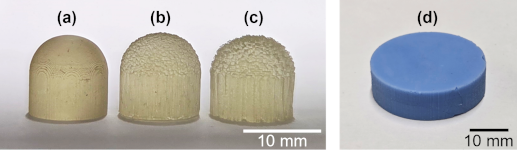
These structures were generated on the virtual model of the specimen using the open-source 3D software Blender (version 4.3.2 by the non-profit Blender Foundation) before the specimen was fabricated via stereolithography (SLA) on an Asiga Pro2 printer. As build material, a commercially available methacrylate-based resin (audioprint GR-1 by pro3dure medical GmbH, Iserlohn, Germany) specifically designed for the production of hard earmoulds and in-ear shells was used. The spherical geometry enables a localized contact with the planar surface of the silicone cylinder.
The specimens were printed with a layer height of 0.05 mm and the subsequent post-processing consisted of 15 min of cleaning in an isopropanol bath, followed by 30 min of UV curing at a temperature of 60°C.
The surface of the ear canal was modelled using an elastic silicone cylinder with a hardness of 43 Shore A in order to approximate the mechanical properties of the human ear canal tissue, following the general approach of selecting surrogate materials based on Shore hardness for soft biological tissues [6]. The chosen geometry provides a reproducible contact area for the tribological investigations. The silicone cylinders were manufactured using a 3D-printed injection mould.
2.2 Tribology
The tribological measurements were carried out using an Easy Tribology Screener (ETS) oscillation tribometer by Optimol. The schematic experimental setup is shown in Figure 2 [Fig. 2]. The silicone cylinder was brought into contact with the fixed test specimen under a constant normal load, while the elastomeric cylinder underneath was subjected to an oscillatory motion.
Figure 2: Schematic experimental setup. The friction force occurs opposite to the direction of the oscillatory stroking motion of the silicone cylinder.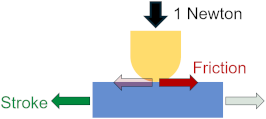
The normal force was set to 1 N in order to reproduce realistic in-ear conditions. This value was identified as a typical parameter for measuring friction on human skin [7], [8]. The oscillation frequency was fixed at 1 Hz, corresponding to a typical chewing frequency [9]. The stroke amplitude, which represents the key varying parameter in this experiment, was chosen with reference to characteristic deformations of the ear canal region induced by jaw motion, as jaw motion is known to induce substantial geometric changes of the cartilaginous ear canal [10]. The stroke amplitude was increased stepwise from an initial value of 0.25 mm in increments of 0.25 mm up to a final value of 3 mm [11]. Each stroke setting was held for 180 s. All experiments were conducted at an ambient temperature of 37°C to approximate body temperature [12], [13]. Throughout the measurements, both the lateral force and the normal force were continuously recorded, enabling to calculate the coefficient of friction over time.
3 Measurement and analysis
Commonly, the coefficient of friction describes the ratio of friction force to normal force between two bodies in relative motion. In the present setup, however, a compliant medium is used that deforms elastically. Consequently, the measured coefficient of friction is interpreted as a measure of the tribological system’s response to the external excitation.
Figure 3 [Fig. 3] illustrates a representative example of the tribological measurements, showing both the coefficient of friction and the stroke as a function of time in a line plot. The stroke, shown as a grey line, increases stepwise from 0.25 mm to 3.0 mm over the course of the experiment. In parallel, the coefficient of friction, shown as a black line, exhibits a time-dependent evolution that reflects the individual stroke intervals. The coefficient of friction initially increases and reaches a global maximum at a stroke of 2.0 mm, within the time interval between 1,260 s and 1,440 s. Beyond this point, the coefficient of friction decreases again with further increasing stroke.
Figure 3: Results of the tribological measurement: coefficient of friction and stroke as a function of time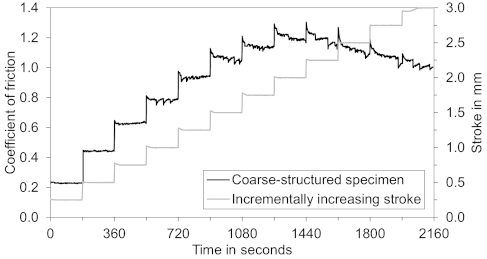
The evolution of the coefficient of friction over time can be divided into two phases as shown in Figure 4 [Fig. 4]. The first phase extends from the start of the experiment up to 1,260 s and thus comprises the first seven intervals, during which the stroke is gradually increased. This phase is characterized by a stepwise rise of the coefficient of friction from 0.25 to 0.6, with each interval of 180 s exhibiting a plateau. Subsequently, between 540 s and 1,440 s, corresponding to the next four intervals, the curve transitions to a pattern with local maxima occurring at the beginning of each interval in which the stroke is increased. At the same time, the plateaus no longer remain flat but display distinct drops and irregularities.
Figure 4: Temporal evolution of the coefficient of friction showing a two-phase behaviour as the two regimes are divided by the point of interest at the critical stroke. The initial phase with stepwise increase and plateau formation up to a critical stroke of 2.0 mm, followed by a second phase with decreasing friction despite further increase of the stroke.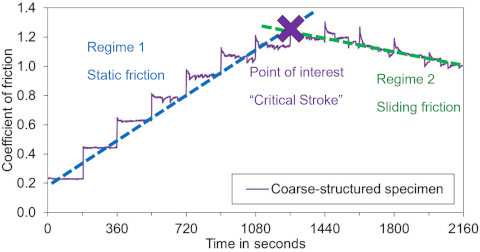
The second phase begins at 1,260 s and is characterized by the absence of the continued increase observed in the first phase; instead, the coefficient of friction decreases incrementally with each subsequent time interval. The transition between the first and second regime occurs at a stroke of 2.0 mm and indicates that the tribological system no longer responds to the external excitation induced by further increasing the stroke from 2.0 mm to 3.0 mm. This critical stroke marks the phase transition, which will be examined in more detail below.
4 Results
The influence of different surface structures is presented in Figure 5 [Fig. 5]. The line plot shows the coefficient of friction over time for three different surface structures. Each specimen produces a distinctive friction curve. As the surface roughness increases, the friction curves shift to higher values.
Figure 5: Comparison of the differently structured counter bodies. The cross indicates the critical stroke corresponding to the onset of failure. The yellow area marks the average range of motion induced by jaw movement.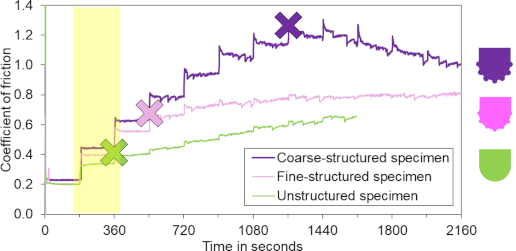
Each curve displays a two-phase pattern. Initially, the coefficient of friction increases in a stepwise fashion and subsequently transitions into a regime where the curve no longer shows discrete steps but instead follows a more nearly linear trend. These transitions occur at different times, and thus at different stroke amplitudes. The critical stroke at which a further increase of the stroke no longer produces a stepwise increase in the coefficient of friction is marked by a cross for each curve and increases with increasing surface roughness.
For the unstructured specimen, the critical stroke is reached after 360 s. For the structured specimens, the critical stroke occurs at 540 s for the finely structured surface and at 1360 s for the coarsely structured surface. The corresponding coefficient of friction at the onset of the critical stroke increases as well, from 0.39 for the unstructured specimen to 0.7 for the fine structure and 1.2 for the coarse structure.
The yellow area marks the average range of effective deformation of the ear canal that is induced by jaw movement. Evidently, the critical stroke of the unstructured specimen lies within this effective motion range. In contrast, by introducing surface structures, the critical stroke can be shifted beyond the interval covered by typical jaw movement. Therefore, increasing the properties of adhesion and reducing the risk of an unintended loss of the hearing aid by falling out.
5 Conclusion and outlook
A complex in-ear situation was successfully transformed into a controlled and quantifiable laboratory experiment. We have introduced an oscillatory tribometry method to characterize the adhesion behaviour of additively manufactured earmould surfaces against a silicone analogue of the ear canal. By monitoring the coefficient of friction under stepwise increases of the oscillating stroke at constant normal force, a critical stroke could be identified that marks the transition from an adhesion-dominated, secure contact to a sliding-dominated, failing state.
This critical stroke provides a quantitative and functionally meaningful metric for comparing different surface topographies. Surfaces with higher critical stroke values can tolerate larger jaw-induced motions before transitioning into the sliding regime.
Moreover, this approach is well suited to investigating the influence of sweat and cerumen. By introducing controlled amounts of artificial sweat or cerumen-like contaminants into the contact area, it is possible to assess how the critical stroke changes under more realistic conditions.
Notes
Funding
This work was supported by the “KMU-innovativ” program, funded by the German Federal Ministry of Research, Technology and Space (BMFTR), reference number 13XP5223D.
Conference presentation
This contribution was presented at the 28th Annual Conference of the German Society of Audiology and published as an abstract [14].
Competing interests
The authors declare that they have no competing interests.
References
[1] Kolpe VV, Oliveira RJ. Chemistry and Rheology of Otoplastic Materials. Semin Hear. 2003;24(04):289-98. DOI: 10.1055/s-2004-815553[2] Anai M. The Evolution of Earmold in Hearing Aid Technology, Applications, and Innovations. J Commun Disord. 2024;12(1):282.
[3] Lin W. Improve reliability of hearing instruments using nano technology. In: IEEE, editor. 2015 International Conference on Manipulation, Manufacturing and Measurement on the Nanoscale (3M-NANO). Changchun, China, 05.10.2015 - 09.10.2015. IEEE; 2015. p. 290-3. DOI: 10.1109/3M-NANO.2015.7425466
[4] Bennett RJ, Laplante-Lévesque A, Meyer CJ, Eikelboom RH. Exploring Hearing Aid Problems: Perspectives of Hearing Aid Owners and Clinicians. Ear Hear. 2018;39(1):172-87. DOI: 10.1097/AUD.0000000000000477
[5] McCormack A, Fortnum H. Why do people fitted with hearing aids not wear them? Int J Audiol. 2013 May;52(5):360-8. DOI: 10.3109/14992027.2013.769066
[6] Kriener K, Sinclair K, Robison G, Lala R, Finley H, Richardson WJ, Midwinter MJ. Investigating the Reliability of Shore Hardness in the Design of Procedural Task Trainers. Bioengineering (Basel). 2025 Jan;12(1):41. DOI: 10.3390/bioengineering12010041
[7] Veijgen NK, Masen MA, van der Heide E. A novel approach to measuring the frictional behaviour of human skin in vivo. Tribology International. 2012;54:38-41. DOI: 10.1016/j.triboint.2012.05.022
[8] Vilhena L, Afonso L, Ramalho A. Skin Friction: Mechanical and Tribological Characterization of Different Papers Used in Everyday Life. Materials (Basel). 2023 Aug;16(16):5724. DOI: 10.3390/ma16165724
[9] Po JM, Kieser JA, Gallo LM, Tésenyi AJ, Herbison P, Farella M. Time-frequency analysis of chewing activity in the natural environment. J Dent Res. 2011 Oct;90(10):1206-10. DOI: 10.1177/0022034511416669
[10] Oliveira RJ, Hammer B, Stillman A, Holm J, Jons C, Margolis RH. A look at ear canal changes with jaw motion. Ear Hear. 1992 Dec;13(6):464-6. DOI: 10.1097/00003446-199212000-00013
[11] Darkner S, Larsen R, Paulsen RR. Analysis of deformation of the human ear and canal caused by mandibular movement. Med Image Comput Comput Assist Interv. 2007;10(Pt 2):801-8. DOI: 10.1007/978-3-540-75759-7_97
[12] Levander MS, Grodzinsky E. Variation in Normal Ear Temperature. Am J Med Sci. 2017 Oct;354(4):370-8. DOI: 10.1016/j.amjms.2017.05.013
[13] Olson KD, O'Brien P, Lin AS, Fabry DA, Hanke S, Schroeder MJ. A Continuously Worn Dual Temperature Sensor System for Accurate Monitoring of Core Body Temperature from the Ear Canal. Sensors (Basel). 2023 Aug;23(17):7323. DOI: 10.3390/s23177323
[14] Joukov V, Mallwitz HH, Kreikemeier S, Albrecht J. Optimal sitzende Ohrpassstücke mittels additiver Fertigung: Charakterisierung der Hafteigenschaften im Tribologielabor. In: Deutsche Gesellschaft für Audiologie e. V., editor. 28. Jahrestagung der Deutschen Gesellschaft für Audiologie. Oldenburg, 04.-06.03.2026. Düsseldorf: German Medical Science GMS Publishing House; 2026. Doc158. DOI: 10.3205/26dga158